 2902 N.W. 22nd St. Miami, FL 33142
Professional Concrete Repairs
Snapp Industries, Inc.
offers a variety of concrete services
in all of South Florida. With over 75 years of experience, our professional technicians always provide exceptional work. From repairing a sidewalk to full structural improvement to your home or business, no job is too big or too small for Snapp Industries, Inc. To schedule a consultation or for a free estimate, call (305) 635-0687
or stop by our location in Miami, Florida.
Spalled Concrete
When the rebars located inside steel-reinforced concrete rust, the concrete eventually cracks, which in turn weakens the structural members of a building or house (tie beams, columns, slabs). Spalled or cracked concrete is very common, especially in areas located near bodies of saltwater. Concrete is a porous material and like a large sponge it soaks up the outside elements. The salt in the air speeds up the corrosion process that causes concrete to crack. Concrete may also crack prematurely if the rebars are not adequately covered with concrete. In order to repair spalled concrete, Snapp Industries, Inc.
sandblasts the rusted steel and replaces the steel rebars and recovers it with gunite (pneumatically sprayed concrete). The use of gunite enables our technicians to repair spalled concrete quickly and affordably.
Pressure Grouting
This method is used to re-stabilize pools, foundations, and footers. Portland cement is pumped beneath the ground in order to fill voids and compact loosely consolidated soils. A hydraulic pump pushes the "slurry" grout material through a hose connected to a hollow galvanized steel pipe. This pipe is driven down to a solid base or bedrock before pumping commences. Gradually the grout material works its way up from the solid base until it reaches the bottom of the foundation. For additional information call Snapp Industries, Inc.
at (305) 635-0687.
Membrane Application
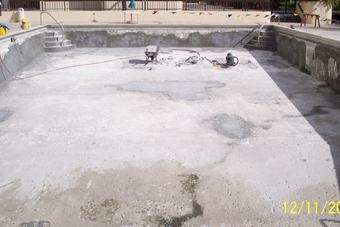
This system is applied to above grade pools when a pool is leaking. Usually, the pools are built above parking garages or living quarters. The reinforced concrete that makes the pool shell may be cracked, which contributes to the leaking. The picture on the left shows a pool that is in the process of being repaired. Here you can see the gray patches are areas that were cracked. Gunite was applied to these areas after the steel was replaced. For additional images click here
to see the gallery of our previous projects.
PIN PILES
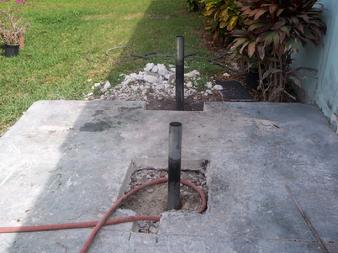
Pin piles are small-diameter (3 to 4 inch) schedule-40 galvanized pipes. They are driven into the ground with a hand-held or excavator-mounted jackhammer. The weight capacity for a 3-4-inch pin pile is 10,000 pounds each. Short pipe lengths, usually 5-feet, are used and are mechanically welded together. They are driven down until they reach a solid base or bedrock. This permanently stops a structure from settling. Snapp Industries, Inc.
professionally installs pin piles to residential and commercial properties. Call us today at (305) 635-0687
for additional information.
Epoxy Injection
This is a process used to repair all different types of concrete structures. An epoxy is forced through the crack, under a high rate of pressure, filling the cracks and welds them together structurally. This procedure forms a bond that is stronger than the original concrete. Snapp Industries, Inc.
has over 45 years of experience epoxy injecting many concrete structures such as pools, parking garages, columns, beams, floor slabs, rib joist, pilings, etc., in South Florida.
Chemical Grouting
Chemical grouting, also known as urethane injection is a method used to seal leaking cracks, fractures, joints and holes in concrete and masonry structures. When cured, the grout forms a closed-cell elastic gasket that stops water with a three-way seal, chemical bond, mechanical bond, and compression seal. Snapp Industries, Inc. uses chemical grout to stop leaking water in parking garages, pools, fountains, planters, etc. We work with residential and commercial clients. Call us at (305) 635-0687
for a free estimate today.
Additional Services
Sandblasting
Seawall Repairs
Fill-Cell Columns
Seawall Repairs
Fill-Cell Columns
Wood Sub Floor Repairs
For further information about Snapp Industries, Inc. in Miami, Florida, a free estimate, or to schedule a consultation, call
(305) 635-0687.
Or email us at
info@snappind.com.
 2902 N.W. 22nd St. Miami, FL 33142
 info@snappind.com
 (305) 635-0687
 (305) 638-2131




